


When hip pain occurs, the questions about what to do and how to treat the condition are among the most exciting.The hip joint is one of the most important and heavily loaded joints in the entire musculoskeletal system.Loss of mobility due to pain may partially or completely deprive a person of mobility.The answer to how to treat pain problems is simple – identify and eliminate its cause.
Possible causes of hip pain
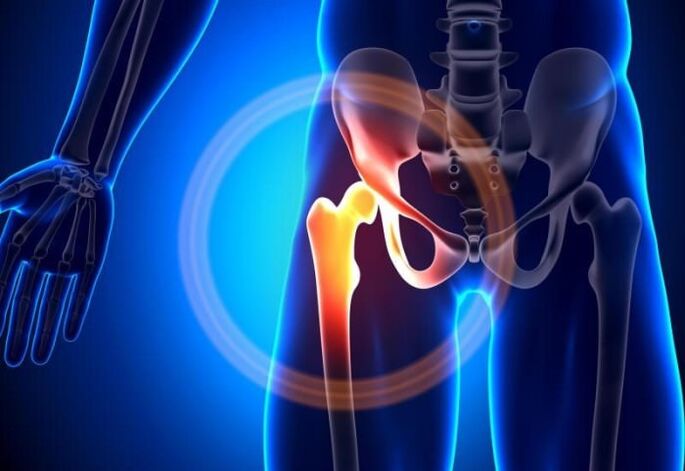
First, you need to pay attention to when hip pain occurs.This can happen at the following points:
- When getting up in the morning;
- During physical activity, when running;
- When walking normally;
- In a state of no action.
It pays to listen to your body and try to discern the systemic nature of the pain.
Important!In hip disorders, pain may radiate into the legs due to the structural characteristics of the nerve bundles.This condition reaches such an extent that the patient believes until the last moment that he or she has injured his leg or knee, without even suspecting that the source of the pain is in the hip.
The nature of hip pain can also vary.The following types of hip pain occur:
- pain;
- periodic acute;
- Sudden acuteness.
It is necessary to accurately determine the main cause of hip pain.
trauma
In most cases, this is preceded by a fall or a sharp jump from a height.Signs of injury include:
- severe pain;
- edema;
- restrict movement;
- visual distortion;
- Unable to rotate the foot outward.
An injury is a dislocation, fracture or bruise.
Hip arthropathy
This is an arthropathy of the hip joint, a degenerative change in its cartilage and bone tissue.Symptoms of hip joint disease are as follows:
- austerity;
- Stiff movements;
- Pain and periodic acute pain;
- Pain worsens in bad weather and at night;
- deformation;
- swelling.
Most of the time this happens to older people.
Trochanteric bursitis
Inflammation of the trochanteric bursa, or bursa, contains synovial fluid is called bursitis.The source of pain is usually in the buttocks.The pain will be worse if you lie on a damaged joint.Exacerbations occur at night.
systemic lupus erythematosus
This is an autoimmune disease.Your own cells are attacked by the immune system, causing inflammation in your muscles and joints. Symptoms of lupus are as follows:
- high temperature;
- Blisters and ulcers on mucous membranes and skin;
- muscle weakness;
- Joint and muscle pain.
There may be just one symptom, or all symptoms may occur at the same time.But usually you start with one and then the rest join.
arthritis
Generally, this is inflammation of the hip joint.The cause may be a partial or complete lack of the shock-absorbing cartilage layer between the bones, or an infection.Symptoms other than pain include:
- The local temperature of the painful area increases;
- edema;
- Severe pain when moving.
Arthritis can be primary infectious arthritis or secondary arthritis caused by an injury or joint.
synovialitis in pregnant women
As a pregnant woman's body prepares for delivery, the bones in the symphysis area gradually move apart.This disease is only possible during pregnancy, most commonly in the second or third trimester.The symptoms are as follows:
- pubic pain;
- Swelling of the affected area;
- severe pain when walking;
This often causes women severe pain when moving and changing positions.When resting, there is no pain.
Aseptic necrosis
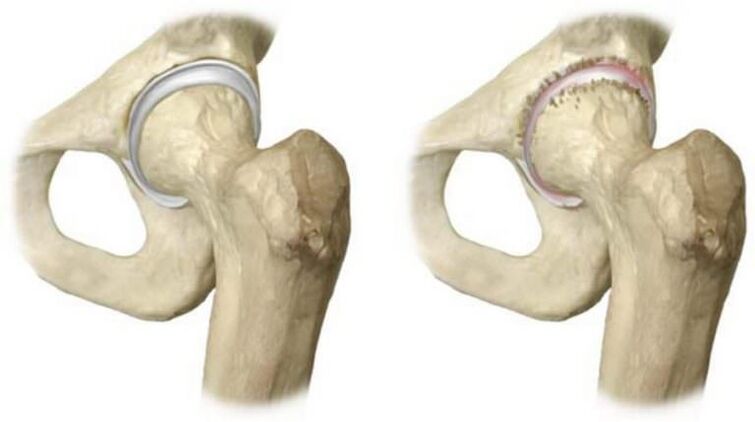
Necrosis is the death of tissue due to insufficient blood supply.In most cases, it affects the head of the neck or hip joint.This can happen for a variety of reasons:
- Stress due to injury;
- loss of information due to injury;
- blood clots;
- A disease that makes the blood thicker.
The disease progresses quite quickly and affects younger people more because they are more active.
oncology
Unfortunately, since the tumor was already in its final stages, something was starting to hurt.There are few symptoms in the early stages.But once pain occurs, it cannot be relieved with ordinary painkillers.Risk factors for developing sarcoma or myeloma are trauma and long-term inflammation.The pain may be accompanied by swelling and fever.
fact!The pain may subside for a while and then return to life again.The severity of hip pain is directly proportional to the size of the tumor.
In most cases, right or left hip pain is caused by one of these causes, but in rare cases, it may be something else.
diagnosis
For hip pain, your best bet is to contact your general practitioner or rheumatologist.The specialist will examine and palpate the joint and choose a diagnostic method.Diagnostic methods can be as follows:
- Blood tests for inflammation and infection;
- Hip ultrasound;
- tomography;
- radiography;
- Bone scintigraphy in case tumors are suspected;
- Magnetic resonance examination.
After making a diagnosis, the doctor will begin to treat the hip pain himself or, if the specific case is not within his competence, he will refer you to a more specialized specialist.
Several experts treat conditions that cause hip pain:
- Neurologist;
- orthopedic surgeon;
- allergist;
- Oncologist.
When you know the cause, the answer to the question when choosing a treatment becomes obvious.

treat
When hip pain occurs, a variety of treatments may be needed, depending directly on the diagnosis.
If injured, the patient must immobilize the limb and await further instructions from the attending physician.If a fracture or dislocation is detected, the damaged area can be reduced and immobilized with a cast or knitting pins, if necessary.Medications that promote rapid regeneration and complete rest are then prescribed.
For syndesmosis of pregnancy, supplementing with calcium and vitamin D (stores of these are depleted by the growing fetus) often helps.
Cancer Treatment:
- radiation therapy;
- chemotherapy;
- Bone marrow transplant.
In cases of joint degenerative changes, they usually start with a conservative approach.
drug treatment
The following types of medications are used to treat hip joint disease:
- Anti-inflammatory.In order to relieve the inflammatory process, in most cases it is necessary to eliminate the cause of inflammation.However, in addition to this, topical ointments are also used.
- Hormones fight inflammation.
- Chondroprotectant.They are designed to accelerate the regeneration of interarticular fluid and hyaline cartilage.
- Painkillers.Anti-inflammatory creams almost always contain pain relievers, but for severe pain, they may not be helpful.Stronger drugs are then prescribed.This is done not to heal a person, but to free him from severe pain and gain strength.
Basically, these drugs are used in combination.
operate
In the advanced stages of hip arthritis, when the layers between bones have almost disappeared and the person can no longer walk, surgical intervention may be necessary.During this period the following operations will take place:
- Replacement of parts of the joint or cartilage layer;
- removal of tumors;
- Fusion of bones.
The following treatments are often used as a supplement to medication or during recovery after surgery:
- Therapeutic exercise.Its classic version and author's curriculum system.
- physiotherapy.Mud baths, electromedication and laser exposure.
- massage.With its help, blood circulation is improved and lymph fluid is dispersed.But massage can cause inflammation.
All the physical effects are intended to improve blood circulation, which will lead to faster healing afterwards.But at first glance, it may seem like your health is only getting worse.
course

The author's exercise therapy is becoming more and more popular.Essentially, this is the same physical therapy, where the exercises are based on mobilizing the body's own resources, not only on the physical level, but also on the psychological level.
Interesting!The author of this technique firmly believes that the patient must believe that his bones cannot be injured because they cannot be injured - the muscles are injured and can be restored by exercise.
All simulators used for training with this system were developed by the author himself.
Before proceeding with joint movement therapy, you need to know the following contraindications for degenerative changes in the pelvis:
- acute pain;
- oncology;
- pre- and post-infarct status;
- temperature rise;
- postoperative recovery;
- inflammatory process;
- Significantly overweight.
There are several other unproven techniques for treating conditions that cause hip pain:
- leech therapy;
- osteopathy;
- traditional methods;
- ozone therapy;
- acupuncture;
- Su-jok therapy.
They may have helped a lot of people, but relying solely on this method is dangerous because time is often wasted, and time is priceless in this situation.